Wednesday, July 21, 2010

To The Netherlands and Home


July 11 - To The Hague, Netherlands then Home

I couldn’t leave the blog unfinished. So here’s the last installment….for now.

Very early in the morning we left for the airport to get on our (Easyjet) flight to Amsterdam. Everything went like clockwork until we got in the air and the pilot announced that a cockpit warning light detected a problem with one of the rear doors. We would have to return to Madrid and have it checked out. Darn.

We landed safely without any incidence. The door problem was corrected but some other issue surfaced preventing us from taking off. It too was resolved. But then the pilot reported that he was having problems getting another flight plan approved and it would be a little longer before we took off.

About two hours after returning to the Madrid we finally got back in the air. This time everything went smoothly. We arrived in Amsterdam an hour later. Schiphol is truly a world class airport. It has lots of good shops, restaurants, hotels and great ground connections by train and bus right at the airport.

We got train tickets and made it to The Hague in no time. We had reservations at a small hotel in Scheveningen, Hotel Corel. It was a big, stark change from the Hilton in Madrid. Small, two old twin mattresses, shag carpeting, a broken toilet seat and an (intrusive) view of apartments next door (and they to us, of course). This was a three star hotel? However, the breakfast next morning was superb and its proximity to the boardwalk area of Schevenigen was excellent.

Holland was getting ready for an epic World Cup soccer championship game against Spain. Fountains were spewing orange water and lots of people were walking around with orange clothes. Excitement was building. Incidentally, orange is the color of the Dutch royal family - the House of Oranje. But today, the color orange mostly symbolizes being Dutch.

We ended up just walking around visiting familiar spots, sipping coffee or beer at cafes and enjoying the sights for two days. After that we took the train to our friends Maarten and Maria in Amstelveen (near Amsterdam).


We stayed with them for another two days. We ate a special dish Maarten cooked up - pulpo (octopus). They had brought back from Spain after their son had spearfished it. Very tasty. We helped M&M plan their upcoming trip to California and went out to eat at the Blauw Indonesian restaurant in Amsterdam to have rijstavel, a very typical Indonesian dinner consisting of about twenty separately prepared dishes. Delicious.


In the morning, M&M took us to the airport to catch a KLM flight back to LAX. Vacation was over. 

Sunday, July 11, 2010

Aranda de Duero and back to Madrid

Aranda de Duero and back to Madrid


We drove south to Aranda de Duero and checked into Hotel Julia, in the center of town. Aranda is not known for anything particular, though tourists do come here for the lamb roast, reportedly the best in Spain. Also, like Laguardia, it too had underground wine caves, of which we visited one. We just came here as a pit stop between Rioja and Madrid. But surprisingly, we liked the town. 

Aranda has a nice river running through it and a city park abuts it. We settled into a spot in the park near the bar (which is right next to the kiddy playground). Young mothers can have a glass of wine while they watch their toddlers play. Very cultured.

The park truly exemplified Spanish family life. Families, eating, playing, fishing and otherwise enjoying the park. Several dads were walking around with their young toddlers. Diane spotted some young parents smoking around their babies at times blowing smoke near their faces. That kicked in Diane’s anti-smoking campaign. She marched over to the young parents and gently scolded them in Spanglish. They all reacted with surprise as if they hadn’t thought about the impact of the smoke to their babies. I think she did some good, at least making those parents think twice before blowing smoke into the faces of babies.     

We drove back to Madrid the following day with a detour to a city that was at the center of Islam in medieval days - Guadalajara. We visited the Gothic Palacio del Infantado, a relatively plane looking palace from the outside with a beautiful façade courtyard. We had lunch near the palace, on a park bench, munching on a bagget, cheese, ham and fruit. 

Later that afternoon we arrived back at Gys and Paloma’s pink villa in Madrid. Of the three kids, only Diego was left home - and he was off to the north of Spain in the morning for surf camp, Marina and Julia already were at their activity camps.


In the evening the five of us set off to a nearby Peruvian restaurant. We started off with a strong Peruvian drink, a Pisco Sour, made of egg white, limes, sugar and Pisco. That was followed by several exotic appetizers ranging from a ceviche, to a baked dish with potato and octopus. I was about full from the appetizers, when dinner arrived - for me, a lightly cooked fish with yet another type of potato (Peruvians have over a hundred types of potatoes). Luckily, a couple of good bottles of Rioja wine enabled me to consume the dinner too. It was  a scrumptious meal. No room for dessert, though.

On our last day in Spain we stayed at the Madrid Airport Hilton, since our Easyjet flight to Amsterdam was an early one. The hotel décor was ultra-modern, nothing like the hotels we’d been staying at. But our room was roomy and comfortable, the pool, nice. In the evening at dinner, we watched Germany beat Uruguay 3-2, in what was a fun and exciting game to watch.    

The Rioja Wine Region

July 7 -  Wine Tours in Rioja


On Wednesday, after a superb breakfast at our inn, we drove to the nearby town of Briones where the bodega Dinastia Vivanco has a wine museum.  It’s an amazing museum, in that it details the entire history of wine, the process of wine making and all its related functions, such as the making of barrels, bottles, corks and even cork screws. It took us a full two hours to get through it (at a quick pace). Afterwards, we took a tour of the Vivanco Winery, which was good yet disappointing, in that it was all in Spanish.


When we got back to our winery/hotel, Jesus Puelles, the owner, was ready to give us a personal tour of the winery - in English. The Puelles winery dates back to the early 1800’s and, though not nearly as big as Vivanco, it’s impressive. They follow organic vineyard practices in growing their (mostly Tempranillo) grapes. They only use estate grown grapes in their wines and produce about 200,000 bottles a year.

Jesus told us that in Rioja, wineries typically produce a crianza, a reserve and grand reserve. Mostly all are made of Tempranillo. Other red varietals grown in Rioja are Grenache, Mazuela and Graciano. White varietals are Viura and Xarello.The Rioja DOC controls these types of wines by mandating them to be aged as follows: a crianza must be aged in oak for one year; a reserve must be aged in oak for two years and bottle aged for one year; and the grand reserve must be aged in oak for three years and bottle aged for an additional two years. A little different from what we do in California where the winery may tell the prospective buyer to age the wine for a year or two before opening the wine.

One of the ways Jesus sells his wine is through his wine club. Members pay as the wine is made. First they pay up front for the cost of a barrel, then pay for the grapes, lastly for the bottles. In the end, a member gets 300 bottles of wine for about $3 per bottle. Not a bad deal for a good quality wine. But you have to like Tempranillo.

Later that evening, we watched more world football (soccer) action - Spain against Germany. To us it seemed like a pretty even game, not many fouls, played in a very gentlemanly manner. In the second half, Spain got a break and from a corner kick, headed the ball in for a goal to win the game. It will now be Spain and the Netherlands - and we’ll be in the Netherlands for the title game!!!          

After our two-day stay at Bodega Puelles, we reluctantly packed our suitcases and hit the road. We visited, Laguardia, an ancient walled city known for its many underground (cave) bodegas and spectacular views of the area and the Pyrenees. We only stayed for a short time. 


Into the wine country


July 5 - The Alonso del Yerro Winery and the Village of Silos


On our drive north of Madrid, we began to see many vineyards. Our first winery visit had been set up by Gys. He knew the owners, Alonso and Maria. Vinedos Alonso del Yerro http://www.vay.es/  is in a small town of Roa, west of Aranda de Duero and lies within what arguably is the premier wine region in Spain known as Ribera del Duero. It took some serious searching but after a couple of misguided turns we found it.

Maria was waiting by the house and greeted us. She spoke excellent English and showed us the vineyards, talked about their vineyard philosophy and then took us inside the winery. A couple of interesting things I noted from the tour: 1) they have had the soils of all their acreage analyzed and mapped then parceled into different vineyards from which they make their wines. Soils that were not that healthy, they had the soil amended to improve the grape quality. 2) they’ve named each vineyard parcel after one of their four children; 2) they adhere to organic farming techniques, don’t use pesticides and don’t irrigate; 3) one of the things that surprised me was that they fermented the must in huge 5000 liter vertical French oak barrels (they only have Tempranillo) .


After a while, Maria’s husband, Alonso, met us at the house. He spoke little English, so Maria interpreted much of the conversation, but also we practiced hard on our halting Spanish. Alonso background is the pharmaceutical business. He was the CEO of a family-owned company and in his mid-forties decided he needed a career change. In the late 90’s he quit the family business and bought an existing vineyard and started the AY winery. 

He began by hiring top people - one of France’s best wine makers, a soil expert and later an enologist to help get things going. Needless to say, it’s not a winery run on a shoe-string. After the tour, Maria and Alonso invited us to lunch. We enjoyed a fabulous meal prepared by their chef on white linen table clothes served by one of their helpers in the dining room overlooking the vineyard. Each course was served with a different AY wine and culminated with their top wine, appropriately named Maria. Dessert was a delicate and rich chocolate ice cream served in a crystal bowl, followed by an espresso coffee, chocolates and more wine outside. Not a bad lifestyle, I thought.

After our visit with Maria and Alonso, we drove off to nearby Santo Domingo de Silos, a tiny village known for its Gregorian chants by monks from the Benedictine abbey. We stayed at an old inn, the Hotel Tres Coronas, which is situated in the town’s main plaza, across from the monastery.

This is another one of these ancient places. The Visigoths were here as far back as the 7th century. The courtyard of the cloister has a beautiful evergreen tree that we were told by two of the monks, was over 100 years old. Apparently, the cloister has an excellent Romanesque art collection, but we never had a chance to see it. 
 

In the evening, at 7p.m. we went to the cathedral to listen to the monks chant. About thirty monks walked in, candles were lit and the chanting commenced. It was interesting but not as moving as we had anticipated. It went on for about 45 minutes, after which they formed a line and walked passed us on the way out. 

The next morning, after breakfast, we drove north towards Burgos and then eastward to Logrono. Our destination that day was nearby. It was the micro village of Abalos, in the heart of Rioja wine country. We were staying at a hospederia, in this case, a winery/hotel. The Bodegas Puelles is a family run winery that has been around for nearly two centuries! 

We knocked on the door after which an elderly Spanish lady stuck her head out of the window on the second floor. After some discussions (that we weren‘t all that clear of), she decided to let us in. She showed us all the available rooms and told us that we had our pick. She also showed us the pool, the Jacuzzi, sauna and breakfast room. We could get used to this place.

After settling in we took a drive around to find a place to eat. It was 4pm and everything was either closed or the tapas bar offered a selection of day-old sandwiches (that we would not have offered a dog). No open grocery stores either. Even the bodegas were not open. It was a very frustrating afternoon food hunt. But once back at the winery, our luck changed. 

Anna, the bookkeeper at the winery, greeted us and took us into the winery’s tasting room. She spoke good English and offered us a taste of most of their wines. Afterwards, she told us that if we wanted, we could sit outside and have more of any of the wines. All we had to do was ask. Needless to say, we took her up on the offer and stayed put for the rest of the evening.  

Tuesday, July 6, 2010

Madrid, Lozoya and Segovia


June 30 - Madrid

Driving in to Madrid was wild. It certainly is the big city. A place of five million people (the city and its periphery), we immediately got into horrible traffic. Yet slowly but surely we managed to find our way to my cousin Gys’ home.

We knocked on the door of their pink villa and were greeted by Gys and the kids (Paloma was still at work). We had a fun reunion and settled in. Later on after Paloma got home from work, she cooked up a wonderful paella.

In the morning, Diane and I took the bus into Madrid (the subway metro was having a wildcat strike, so traffic was horrific and the bus was jam-packed with people). Driving the car in to Madrid would have been nuts.

Once in Madrid, we toured the Prado Museum, a huge world-class museum with art from medieval times (lots of scenes of the crucifixion) to paintings from the present. Naturally, the museum’s focus is on Spanish painters, including Spain’s best known painters Velasquez, El Greco and Goya. It took us the better part of the day to tour the museum.

The strangest thing happened to us when we were on our way back home. We were waiting for our bus, when another bus stopped and out walked a former colleague of mine from Cal Poly. He was in Madrid with his two sons to celebrate his grandfather’s 90’s birthday. In a city of millions, we wondered what the odds were of meeting someone from tiny SLO


The next day we took the bus back in to Madrid to visit the Thyssen Museum, a more compact but impressive art museum with more of an international flare from medieval times to modern day. Dutch renaissance, French impressionists and modern art - it‘s all there. Afterwards, we walked through the older part of Madrid and saw the palace and Plaza de Mayor. 

One evening, Gys took us to a superb wine store - Lavinia. A huge, high-end store with wines from around the world and prices from Eu 5 to Eu 13,000. A young lady took us around the store, showed us their selection of Spanish wines and told us all about the various regions. Needless to say, we stocked up on a variety of Spanish wines.

By staying with Gys, Paloma and kids Julia, Diego and Marina we not only got to experience family life in Madrid, but saw first hand the interactions of a blended Dutch-Spanish family. It was common to hear three languages spoken all at once (Spanish, Dutch and English). But when a discussion heated up, they usually resorted to the fast, loud staccato of Spanish. 

Also of interest, like most of Spain, the family all seemed to be a bit sleep deprived, staying up really late at night and getting up relatively early in the morning (of course, this is summer).


July 2 - Off to the family mountain home in Lozoya

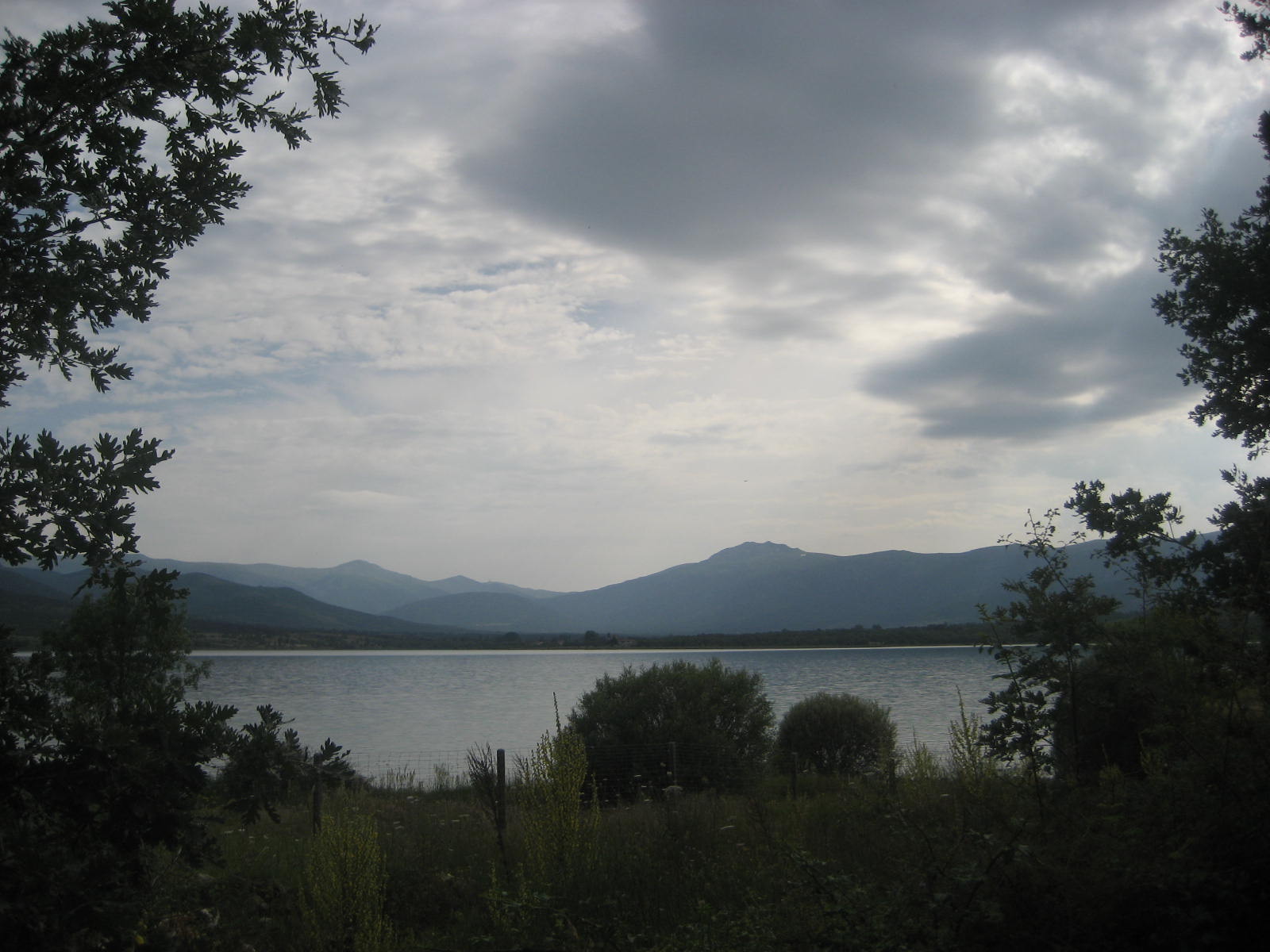
About an hour north of Madrid, Gys has a beautiful home in the mountains overlooking a lake in the village of Lozoya. We spent several days there relaxing in the cool and tranquil setting. We took some short side trips to the village of Rascafria, where there is an old monastery, played “folo” tennis (it’s played on a short court with a paddle and a special ball) and went on a mountain bike ride (just Gys and I) that went straight up the mountain. We ascended from around 2800 feet to just over 6000 feet. I required frequent breaks and ended up having to walk part of it. But I made it! Going down was fast and exhilarating. 
 
July 2 - Side Trip to Segovia


To get to Segovia we took the narrow and windy mountain road from Lozoya. It only took about forty minutes. Our first sight was of the Roman aqueduct that spans the entrance to Segovia. Built in the 1st century, it’s over a mile long, made of granite rock with no mortar and was operational until just a few years ago. That’s not bad for something to be functional for two thousand years!!! The arches are exquisite. One cannot but marvel at the engineering feat of how they constructed the massive arches. 

We then wound our way through the narrow streets to Plaza Mayor, peeking in at the ancient Gothic cathedral on the way to the Alcazar Castle. The castle was quite a sight and had a majestic view of the surrounding hills. Although it looked like something out of Disneyland, one of our tour books stated that it was used in the movie Camelot (with King Arthur and Sir Lancelot). 

On a Sunday afternoon, the typical Spanish family goes out to eat. The feasting can last  for hours. We drove to a huge, local restaurant and did our part. We sat on the veranda and feasted on some local dishes comprised of pork, lamb, salad and yes, wine. Very tasty and filling. 

A couple of things I haven’t touched on. During our stay with Gys and Paloma, she prepared some very nice Spanish dishes for us. The first evening she prepared the quintessential Spanish dish - paella, prepared with a variety of sea food. Other dishes she made included a typical Spanish omelet made with eggs and potatoes; gazpacho, a cold, soup-like dish made with tomatoes, green and red peppers, onions and garlic; a rice dish, also eaten cold, made with white and wild rice, tuna, sardines, capers, olives and tomatoes.

The other thing is that we’ve been watching a lot of soccer - football to the rest of the world. Spain and the Netherlands have been doing well. In fact, there is a chance they could be in the playoffs. It’s been a lot of fun watching all the excitement. 

Monday, July 5, 2010

The Windmills of Consuegra


June 29 - Consuegra and on to Madrid

On leaving Toledo, we decided to double-back a few miles to the small town of Consuegra because we wanted to inspect the classic La Mancha windmills up close.


Winding through these hills one can really imagine Don Quixote riding past these windmills (here they’re called molinos de viento). We stopped at a tourist office housed in one of the mills. The two men working there were among the friendliest and most helpful people met at tourist offices in Spain. They told us all about the history of the windmills and even of the origin of the word Califonia. According to them, it came a Cervantes novel that described a place that he called California. To the Spanish, the far western part of the U.S. turned out to be very similar to the description by Cervantez, so the Spanish ended up calling what they saw California.


Getting back to the windmills in Consuegra, there was a medieval castle that sat atop of the hill where all the windmills were situated. We toured the small castle, which offered great panoramic views of the area. As we entered the castle, we could see that the perimeter walls were five meters thick! The castle itself was in the process of being restored but still offered unique insights on how the knights lived back in the 12th and 13th century. As in so many of these places we‘ve seen, again, it was the destructive Napoleonic forces that unleashed all the damage done to these old buildings.

In the end, we were glad we had made the effort to come to see where Don Quixote had ridden.

Holy Toledo!

June 27 - Toledo

It took about three hours to drive from Cazorla to Toledo, retracing some of our steps past the towns of Ubeda and Baeza. One of the amusing oddities you can spot along the highways are huge black silhouettes of bulls. In the U.S. I’m sure they’d have company logos on them. Here not. Just big and black.


Toledo is in La Mancha country, where there is something other than olive trees - we started seeing fields of grape vines all around. On approaching Toleda, we saw some of the famed white windmills too and were pretty sure we got a glimpse of Don Quixote riding on his horse.

Toledo is on a hill and is one of the old ,walled cities. We crossed the Tagus River and then entered through a large, arched gate. This the town of the famous painter, El Greco.
We found our hotel, Alfonso VI, quickly and were able to park right next door. The hotel was in the middle of the old part of town, opposite the Alcazar.


After settling in, we visited the main cathedral, and walked what we thought was the El Greco museum. We paid the entry fee only to find out once inside, that it was the Iglesia de Santo Tome, a famous small church that houses one of El Greco’s most famous painting - Burial of the Count of Orgaz.

Toledo was pretty typical of the old, walled medieval towns we had been visiting. During our stay in Toledo, we followed some of the winding, narrow streets to find tiny plazas and nooks with cafes, bars and stores carrying ceramics, knives, swords and the kind of armor knights used to wear. I don’t know who buys that stuff - maybe some of the throngs of Japanese tourists we saw wander through the streets.

We walked through the Jewish quarter and down to the Tagus River and got a glimpse of Toledo from the other side - a view that El Greco used to paint one of his paintings. But I think he must have gone a bit further out. The view we saw was good but not as dramatic. 


One Toledo’s main plazas, Zocodover, was very near our hotel. It had a lot of granite benches to sit and people watch. On the outskirt of the plaza are restaurants and even a Mc Donald’s. We checked the menu, and yes, it sold wine and beer. 

We often make do with tapas for dinner because restaurants open so late at night. It still is hard for us to eat at 9pm or later, when the typical Spanish are starting to head for the restaurants. Our routine has consisted of having wine and cacahuetes (peanuts) in our room in the afternoon, heading out for a walk and ending up at a tapas restaurant for an (early) bite to eat.