Friday, February 10, 2012


February 4-10, 2012

We drove from Hopkins to Belize City in about two and a half hour, turned in the rental car and took the water taxi to San Pedro on Ambergris Caye. We split up from the Thunens after our arrival in San Pedro since their hotel was in the northern part of the island and our accommodations were in the south.

If it hadn’t been for the disappointing room accommodation we got stuck with, the transition from the mainland to La Isla Bonita would have been a seamless one. But it was not to be. The ocean view studio condo should have been called “The Cave” (a very petit one at that). Its view of the ocean should have stated “a peek” from the front porch. But with the assistance of the property manager, we found a larger condo right on the beach closer to San Pedro. Things were looking up!

View from our porch.

Our last week in Belize was geared to relaxing and water sports. Mornings consisted of coffee in a beach chair, reading the paper and watching the docks come alive. On Tuesday the four of us met in town ready for a snorkeling expedition. We booked the trip with Aqua Scuba, who took us to Holchan Marine Reserve and Shark Ray Alley. Both were fabulous.

Sunrise

Early morning in San Pedro.

Since Holchan is a reserve, the sea life has no fear of humans. Curious fish swim right past you, albeit keeping an eye on us. We saw turtles, sting rays, pompano, nurse sharks, eel, tarpon and a variety of smaller tropical fish. We then headed off to Shark Ray Alley. As the boat approached the area, we already could see fish heading towards the boat, looking for a free meal. When the boat anchored, the crew started chumming, throwing out small bits of food and telling us it was time to jump into the water.

A nurse shark coming to dinner.

On a bike ride we took to Captain Morgan's.

An iguana doing a show for us.

Osprey parents watching after of the kids.

View from our next condo.

There were so many sharks, sting rays and skip jacks, that it was difficult to get in. I was the first one and initially was a bit hesitant of jumping in. But these fish were docile and were only interested in one thing - the little bits of chum being tossed at them. It was quite an unforgettable experience.

San Pedro is the quintessential tropical town, with small houses along cobblestone and sandy streets. The water is a clear turquoise with the barrier reef visible from most of the beaches. Aside from Australia, this is the longest barrier reef in the world. From our hotel, we can see a couple of cruising yachts at anchor.

Tuesday's fruit and vegetables brought by sailboats.

The main means of transportation on the island is the golf cart. They are everywhere and they can get annoying - particularly the motorized carts with gas engines. Otherwise, people ride bikes and walk.

Perhaps it’s because San Pedro is so dependent on the tourist trade that the people are nice, but we found the locals to be exceedingly good natured and always friendly. The hawkers always are ready to sell you their wares, but if you decline their offer, they smile, thank you and move on. They’re not pushy. I had lots of offers for exotic smoking tobaccos, even Cubans!

On the diving trip - Blinkie, the dive master.

On our last evening in San Pedro, the Thunens came into town via water taxi. We had a bottle of wine on our porch and then went to dinner at El Patio, a local restaurant. It turned out to be a superb last evening. Good food, good wine, good friends and a great way to end a successful Belize adventure.

Diane found a purse she couldn't resist.

Far right and far left were two of the place we stayed at.

Morning view from our porch.

Another view from the porch.

Local chick on palm tree.

Wednesday, February 8, 2012


John and Diane walking downtown Hopkins - really!


February 2-4, 2012

NOTE: Since I changed the blog format to dynamic views, be sure to double-click on the image or verbiage to get the full story. You can also change the views yourself to the others that are available.

==============

After a hearty breakfast of eggs, bacon and toast, we left Tranquility Lodge for Hopkins, a small Garifuna beach town one and a half hours north (we had briefly stopped there on our way south).  

After going to the hotel we had reservations at (and finding out that they had switched our accommodations from a large, upper floor, double suite ocean view place to a depressingly small set of rooms with a pool view), we bailed and found a far superior hotel right on the ocean for half the price! We were thrilled.

View from the upper deck of hotel room

Since the weather wasn't cooperating, set our sights on rum drinks and food. We had dinner at an authentic Garifuna restaurant. Our host, Stanley, told us about locally made bitters and asked if we wanted to a sample. Being wine makers, we were very curious. After having the tasty and authentic Garifuna cuisine, Stanley brought us a small plastic bottle of the bitters. It tasted earthy and herbaceous and definitely definitely contained copious amounts of alcohol. Stanley told us if we were interested we could find out more about the bitter from the guy who made it - he lived in town.

Miss Bertie's Library in Hopkins

The next day we stopped by the store that Stanley had told us of and looked for a tall black fellow - he's the one that purportedly made the potion. We spotted our man and asked if he was the one who made the bitters. He nodded. At first he didn't seem interested in talking. But soon he warmed to us and began telling us how it was made. It was definitely not the typical bitters we know as the ingredient in making drinks such as a Manhattan. The main ingredient of this bitters was derived from the root of a plant found deep in the jungle. The root is ground into a powder which is then used to prepare a strong herbal tea. 

The final step in making the bitters is to add alcohol. Rum, gin, vodka or brandy is added to the tea to make the elixir potent - perhaps 30-35% alcohol. Our conclusion was that it would make a poor substitute for what we know as bitters. I'm pretty sure one wouldn't want to add this to a Manhattan. But, we did find out that one of its main uses was to make a man strong (a.k.a. a cure for erectile dysfunction). Apparently, it’s the generic jungle version of Viagra. Love potion number nine!!!

The following day we walked around town and met an American woman  who had come to check out Hopkins ten years ago and decided to stay and create a bakery (we can attest to her baking skills). Later that evening we had a superb dinner at Chef Rob’s (a Dutch chef who I chatted with in Dutch for a few minutes).

An exquisite dinner at Chef Rob's

The baker showing off her freshly baked muffins.


If it hadn't been for the rough and windy weather, Hopkins would have been a really superb experience. As it was, we left with a favorable impression of the small town, but we wished we could have had a few hours at the pool or on the beach with some sun.

Don't you love the color scheme?

The following day we headed north towards Belize City, to turn in our rental car and get on the water taxi to La Isla Bonita (a.k.a. San Pedro, Ambergris).      

Monday, February 6, 2012


Our cabin at Tranquility Lodge


January 31- February 1, 2012
 
We left Placencia in the late morning and drove southward toward Punta Gorda. We had a reservation at a jungle lodge called “Tranquility Lodge” but other than reading their website, we had no idea what we were buying into.

The drive was an uneventful one, varying from wooded land made up of thin pine trees to dense-looking jungle. We got to our lodge and were greeted warmly by the owners, Suzanne and Lee.  As they were showing us the cabanas we were immediately taken in with the serenity and the feel for the place.

It turns out that Suzanne and Lee were only one month into their tenure as the new owners of the Tranquility Lodge. They are from Canada (Edmonton, Alberta) as so many of the tourists in Belize seem to hail from. Our cabanas were rustic yet very comfortable with views of the dense jungle vegetation. Lee and Suzanne’s attentiveness and friendliness was unparalleled.  

Arriving at Cyrila's

Our adventures in the area included a visit to Cyrila’s, a cacao farm and to Lubaantun, a unique Mayan site. The tour of the cacao farm was superb. Juan, our host and a cacao farmer, explained to us how the cacao is grown and farmed. Afterwards we sat down at a table as he began to explain the process of how the cacao pod is harvested and made into what we know as chocolate. We cut through the pod, tasted the raw, milky-white looking beans and husked the pod. The process then called for the beans to be roasted. To save time, Juan’s wife had roasted other beans for our tour. He showed us how to crack the casing of the bean and get to the heart of the matter - the cacao bean. 

Juan showing us how to cut open the cacao husk

After we had cracked and assembled a respectable amount of cacao, we gathered all of our production and put it on a ground stone known as a metate. With a stone in hand, he showed us how you meticulously grind the beans into a grainy paste, over and over until it becomes a very fine paste. We each tried our hand at the grinding technique, but he admitted that his wife was really the best grinder. She began moving the rock to a rhythmic beat that soon turned the mashed cacao beans into a smooth paste. It was then ready to be poured on to a cookie sheet with the shape of small hearts. After placing the cookie sheet in a freezer for a few minutes, we all got a chocolate heart - all made from the fruits of our labor. Pretty neat. 

What the cacao pod looks like inside

After the bean is roasted (L), then after we crack it (R)


Diane grinding the cacao on the metate
Juan's wife shows us how it's really done

  
After leaving Cyrila’s, we drove to the Mayan site of Lubaantun, unique because this group of Mayans did not use mortar in their construction techniques. Lubaantun, is nowhere as large as Tikal or Caracol. But it was interesting none-the-less and we were the only tourists at the site, since the road leading to it was a muddy and bumpy mess.

 At the Lubaantun site


A spear head found at the site

This chiseled head is 1300 years old. The guard just  handed it to  me.


Sunday, February 5, 2012


Placencia


January 28-30, 2012

We picked up our car rental in San Ignacio and had an easy drive east to Balmopan. There we turned south on what’s called the Hummingbird Highway, on our way to Dangriga, Hopkins and our destination, Placencia.

The Hummingbird Highway was nice, though not what I would term spectacular. It was verdant and at times jungle-like with not too many potholes.

Our first stop was Dangriga, a town mostly made up of Garifuna folks. Garifunas are descendants of Arawak Indians and West Africans brought over to the Caribbean Islands during the slave trade. We made a couple of passes through the shanty town trying to find something of interest to entice us to stop and eat. But it all looked just a bit too derelict to tempt us in the door for lunch. So much for Garifuna culture. Lunch ended up being a stop at the ubiquitous Chinese grocery store for crackers, cheese, potato chips and beers.

On our way to Placencia, we made a brief diversion to Hopkins to verify that the hotel we reserved was what we expected. Satisfied with our choice, we continued south and arrived in Placencia late in the afternoon. Our room at the Seaspray was spartan and plain, but we figured we weren’t going to be in the room a lot anyway.

Placencia is at the very southern end of a long and narrow peninsula. It’s a low-keyed village with a mix of colorful, clapboard stilt cottages, a narrow street and a walkway that runs between houses, bars, restaurants and shops that sell everything from carved wooden parrots to shell necklaces. 

The narrow walkway through town.

One of a number of shops along the walkway.

Beach front living

Dinner at the Rumfish

We got up early the following morning to go on an all day tour of Monkey River. We met our guide, Lenny, and followed him via the walkway to the town’s dock. After getting situated, Lenny throttled the boat to full speed and soon we were zipping across the water, first in an open bay and later in through narrow inlets lined with mangroves.

After a brief stop at Monkey River village to pick up a local guide, we were on our way up the jungle river. We encountered a variety of wild life, including crocodiles, a boa constrictor, large iguanas, bats, pelicans, ospreys, herons, egrets, ibis, and more. At the furthest point up the river, Lenny drove the boat onto the riverside. We got off and took a hike through the jungle mainly looking for Howler monkeys. The two guides called out and banged on lots of trees to locate the monkeys and eventually were successful in finding a family hanging out in the tree tops, munching on leaves. 

Boarding the boat for Monkey River. 


Three small bats on a tree.

A small, suspicious crocodile.

A Howler monkey swinging around the canopy.

Boarding to go home.

Armed with our cameras, we clicked away, always being sure not to stand directly under the monkeys - they like to make their presence known by pooping on those who stand below them. On our walk, our guide also showed us several plants and trees that are used in medicinal ways by shamans and local healers. There was even a tree that had bark that’s effective in treating impotence in men - he called the Viagra tree!

On the return to Placencia, we tried to find manatees in several spots, but it was to no avail. Our guide told us that the closest kin to a manatee is an elephant. I have no idea, but that’s probably worth checking in to. 

In the evening, we were sitting around the hotel, when we heard the sounds of drums beating. One of the bars near us were hosting Garifuna drummers. It was an amazing display of talent. I’m not one to appreciate long, drawn out drummer solos. But this was different. Four drummers playing different types of drums all beating out a rhythm. It was electrifying to listen to them. 

All in all it had been a pretty good, yet long day. Next on the agenda is further south to Punta Gorda. 

Friday, January 27, 2012


January 25, 2012


Today, Diane and I went off into different directions because I wanted to do a cave tour and she wanted to attend a conference that was being held at our hotel on Mayan medicines and healing. Later she’ll post a briefing on her experience at the conference, which sounded really interesting.

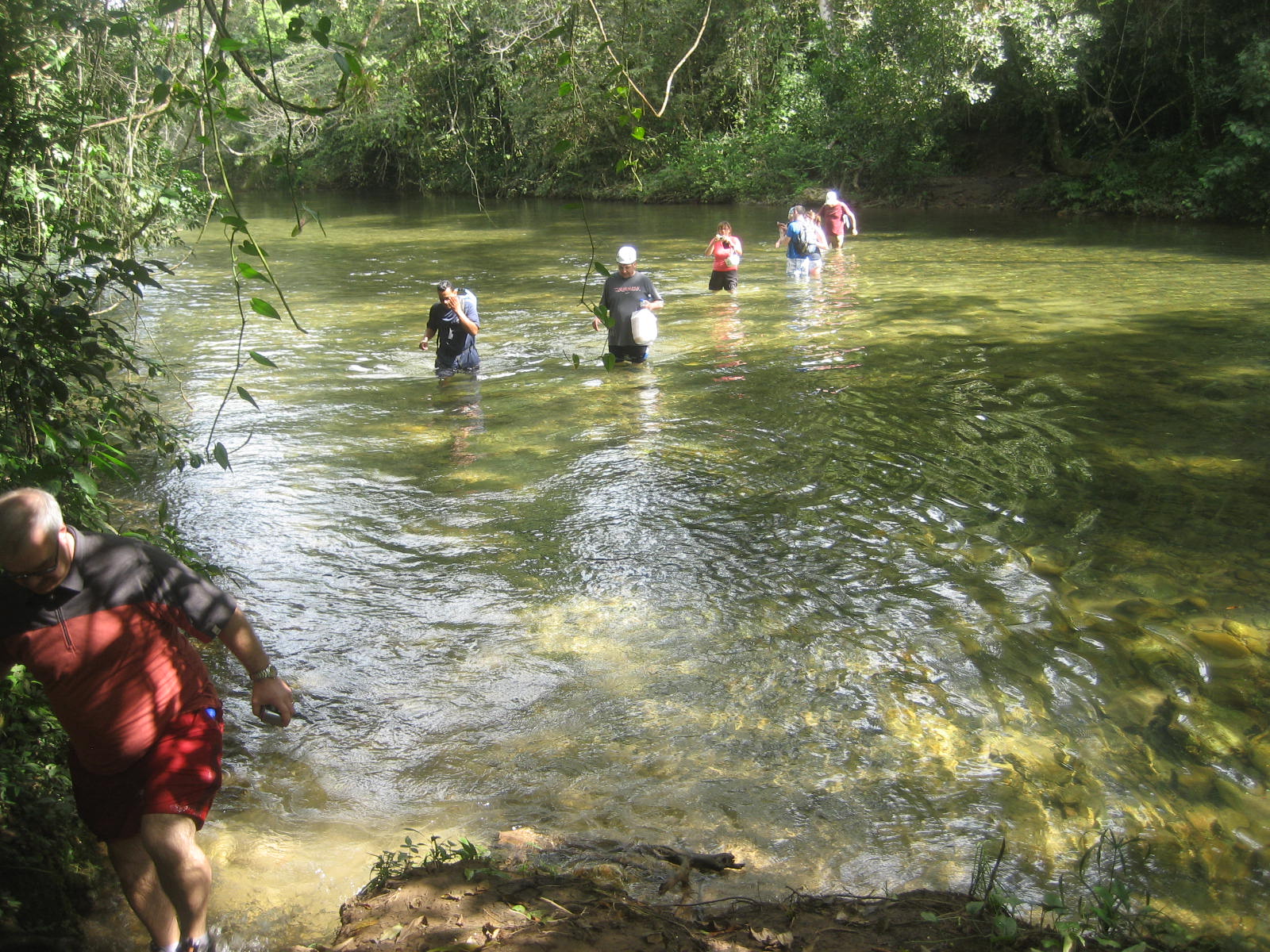
Meanwhile, my excursion with John and Linda, was to Actun Tunichil Muknal, (more commonly know as ATM). We were picked up at the hotel by Carlos, our tour guide. It was a long hour and a half bumpy drive to where we left the vehicle. We then hiked through the jungle for about forty-five minutes, traversing the same river three times.

We got to a picnic/staging area where we had lunch and left most of our belongings. The entrance to the cave was just a few steps from where we had lunch. To enter the cave, we slid off a big rock into the cool water and began to swim. Really!!!

The hour glass entrance to the cave - get ready to swim!

It’s only a short swim, though. Then it mostly consists of walking on rocks or wading in knee-deep water. We wore helmets with headlights attached to them. At one point we were in a spot where one needs to be in the water neck deep. You then squeeze your head through a narrow set of rocks. You accomplish the feat by turning your head forward, then downward and then out all the while moving forward. It was an odd maneuver, but when followed correctly, it got you past the narrow spot and deeper into the cave.

After a relatively easy forty minute trek into the cave we arrived at the main chamber where most of the pottery and human remains were found (there were also beautiful stalactites and stalagmites in the area). There is evidence that the cave was used by the Mayans to host ceremonies and rituals. Some skeletal remains appear to be sacrificial in nature. All these offerings were likely done to appease the underworld gods which were supposed to help the Mayans in times of droughts, famines and wars.

Some of the pottery in the cave

A skull

Stalactites and stalagmites


Heading out of the cave seemed quicker. The experience was unique and I’m glad to have had the opportunity to do it.


January 26, 2012

On Diane’s birthday, we took a trip to Tikal, the biggest Mayan site. It is in Guatemala, about two hours west of San Ignacio. We were picked up early in the morning by Anna, who essentially coordinated the trip for us, taking us through the Guatemalan border and hooking us up with our tour guide for Tikal. We also negotiated for a quick side trip to the small island town of Flores.


Tikal lies in a dense jungle and consists of over 3000 structures (most of which are still buried). In the three hours we were there, we only saw a fraction of it. When you walk up to these ruins from a jungle path, it has the feel of a George Lucas movie. In fact, our tour guide told us that the first Star Wars was partly filmed in Tikal.

There are several different types of structures in Tikal - alters, pyramids, temples and residences. In front of the temples they have stelas, a kind of a billboard that would commemorate a king. Other stelas that were elsewhere essentially reported events and other newsworthy items.

The inspected several of the structures. The main ones we saw were the second set of temples with an acropolis where the rulers were buried in tombs. The interesting part of the architecture of many of these buildings is that each ruler would build, rebuild or add on to an existing building, often making them higher and higher each time. The tallest of the temples (#4) in Tikal is 73 meters. We climbed to the highest part that’s open to the public and were rewarded with a panoramic view of the entire area.


It’s amazing all the excavation that needs to be done at each site. Every mound or hill that’s visible has a structure underneath it. And the more they dig, the more they need to maintain. So archeologists try to only unearth the structures that are deemed to have a special value.

One bit of interesting information that was imparted on us by one of the tour guides was that the Mayan culture was the first to develop the notion of zero. I did a little more research on that and it is believed by many to actually be the Olmec civilization that came with the concept first. The Olmecs preceded the Mayans in the area of Mexico that is now Chiapas - just southwest of Tikal.

After our visit to Tikal, we stopped for lunch and then took the detour to Flores. The small town is actually an island on Lake Peten Itza. There’s a small causeway that connects Flores to the mainland. Flores is a cute little town with colorful buildings, restaurants, gift shops and cobblestone streets. Lots of tuk-tuks (three-wheeled motorcycles with a bench seat in the rear) to move people around the area.

Cobblestone streets of Flores, Guatemala


This is the tuk-tuk

Sittin' at the dock of the bay....


The ride home was long, but the van was pretty comfortable and we got back to San Ignacio just after 6pm just in for a beer and Chinese food at Maxim’s.

January 27, 2012

They taste like chicken!

Today was our last full day in San Ignacio and we pretty much took it easy. We had lunch in town and on the way back Diane and I stopped by for a visit to the Iguana Project and Exhibit. It was an interesting tour, with lots of hands-on experience with fully mature iguanas and baby iguanas.


These are the fully grown ones. I've got Gomez and Diane has the lady.


One of the curious babies.


Too much of a good thing?

Instead of a hair piece, I think I could make this work!


My take away from it was that male iguanas live quite a sumptuous lifestyle. Males have two penises and are very busy during breeding season (Dec-Mar). They’ll mate with as many as six females per day. The bigger and stronger males get all the chicks. They get all spruced up during mating season,  which includes getting a new colorful coat and dropping several pounds. It’s as if they go to the gym and the spa to get ready for the mating season. We got to hold fully grown males and females as well as baby iguanas. Needless to say, the tour was informative and fun.  

Tomorrow morning we pick up our rental car and head south to Placencia.